
Sales Tech Innovations handles your calls, chats, and follow-up messages so that you can be free of having to monitor your queues from dawn till dusk. Below is an honest description of what a good call center services provider will bring to the table, and why more and more businesses in California find themselves choosing us.
Why California Businesses Need Real Phone Support
California is not one market, but several of them combined. Startups of Bay Area, retailers of LA, healthcare companies of San Diego, and farms of the Central Valley operate in separate markets and have separate requirements. The farmer from outside Fresno does not need the same helpdesk that SaaS company from Palo Alto requires – but both will be losing money the moment a phone rings.
This is precisely why a call center services provider must be considered. The internal handling of calls is fine right up to the point where there is a sudden surge of incoming calls, an employee gets sick, or a product launch results in increased call volumes overnight. An experienced outsourcing partner will handle all the stress without the customers even being aware of it. It is this very adaptability which is at the heart of Sales Tech Innovations.
The Best Call Center Services Provider in California
People ask us this a lot, and there isn’t one single answer — it’s a handful of things working together. Agents train specifically on California-based industries, so they pick up on regional compliance details, time-zone overlap, and the tone local customers expect. We also keep account teams small enough that agents remember client details instead of reading from a generic script.
On top of that, we’ve put real money into the technology side — call routing, CRM syncing, live analytics, quality monitoring, all of it refined over years working with everyone from five-person startups to companies with hundreds of employees. When someone searches for the best call center services provider in California, what they usually want is consistency: the same quality on an ordinary Tuesday as during a holiday rush. That’s where most of our effort has gone.
What Inbound Call Center Services Do We Provide?
Inbound work is the backbone of most client relationships, so we’ve built this side out thoroughly. Our inbound call center services in California cover:
- Customer service and general inquiry handling
- Technical support and troubleshooting for software or hardware products
- Order processing and payment support
- Appointment scheduling for clinics, service businesses, and sales teams
- Complaint resolution and escalation management
- Help desk support for internal or external teams
All our inbound agents go through product training before answering their first phone call. It sounds very simple, but quite a number of companies ignore this. Our clients always feel the difference in the first 30 seconds of the call. We prefer to spend one more week training an agent than risking the reputation of our client.
What About Outbound Call Center Support?
Our outbound call center services go well beyond cold calling, though we do run structured, compliant outbound campaigns when that’s the goal. We also cover:
- Lead generation and qualification
- Appointment setting for sales teams
- Customer satisfaction surveys and feedback calls
- Renewal and retention outreach
- Market research calls
- Debt collection support (where applicable and compliant)
As an outbound call center services provider working across the USA, not just California, we’ve learned that outbound work lives or dies on script quality and tone. Nobody enjoys a pushy, robotic sales call. Our scripts get built with client input, tested, and refined based on how real calls actually go, not guesswork.
Why Does 24/7 Customer Support Actually Matter?
Because customers stopped operating on a nine-to-five schedule a long time ago, if they ever did. Someone in Sacramento might have a billing question at 11 PM. An East Coast customer working with a California company is three hours ahead and calling before your office opens. If nobody answers, that customer often just calls the competitor instead.
Our 24/7 customer support call center offered in California ensures that calls, chats, and emails are answered round the clock with night-time and weekend shifts staffed with equally well-trained customer service representatives as the regular day-time shift team and without hiring any inferior team reading a different script altogether. This availability is one of the key reasons why the clients migrate to us from other small companies bound by limited working hours.
Is Outsourcing Cheaper Than Hiring In-House?
Yes, and usually much more than people tend to think when looking at outsourcing call center services in California. The cost involved in establishing an in-house call center includes salaries, employee benefits, office space, phone infrastructure, training programs, management overhead, and staff turnover costs which will always exist anyway.
Here’s roughly how the two approaches stack up for a mid-sized business:
| Factor | In-House Call Center | Sales Tech Innovations (Outsourced) |
| Setup time | 2-4 months | 1-2 weeks |
| Staffing flexibility | Fixed, hard to scale quickly | Scales up or down monthly |
| Technology costs | Paid entirely by the business | Included in service |
| Training overhead | Ongoing, internal responsibility | Handled by the provider |
| Coverage hours | Usually limited | 24/7 available |
| Average cost per agent/month | Higher (salary + benefits + overhead) | Lower, bundled pricing |
| Management burden | Falls on internal staff | Handled by provider’s team leads |
None of this means an in-house team is the wrong call for every business — some genuinely need that level of direct control. But for most small and mid-sized companies across California, affordable BPO call center services deliver comparable or better quality without fixed costs chipping away at margins every month.
How Do You Actually Pick the Right Provider?
A lot of businesses get stuck here, mostly because every provider’s website says roughly the same thing.A few questions which help filter out some of the noise:
Can they provide actual customer results rather than testimonials?
- Are there any trial periods or flexible contracts for a short while?
- Is their pricing structure clear and upfront, without any per-minute hidden costs?
- Do they train agents for your specific industry, or lean on generic scripts?
- Can they scale fast if call volume shifts?
- What does their quality assurance process actually look like?
If a provider hedges on any of these, that’s usually worth noting. Sales Tech Innovations answers all six directly with every prospective client — we’d rather earn the business than talk someone into it.
Need a Call Center Services Provider Near Me?
The location matters despite the industry having become a remote one. The experienced call center solutions provider in your neighborhood in California understands the working hours of your region, the demands of your customers, and what industries make up its economy – be it agriculture, entertainment, IT, tourism, health care, and so on. Our company offers solutions for companies operating in Los Angeles, San Francisco, San Diego, Sacramento, and other smaller towns in between.
That local awareness, combined with nationwide outbound capability, is a big part of why businesses land on us when comparing options. We’re not chasing everyone — we’re trying to be genuinely good at customer support call center work in California, and that focus tends to come through in the results.
Working With Sales Tech Innovations
The first call is not about selling. It’s more about listening – how calls are dropped at the moment, what should be the ideal result in a couple of months from now, and what kind of budget can be allocated for all that. After that, we create a staffing plan, connect the CRM or ticketing system used by the customer, give some training to the sales agents about the product or service, and then start a pilot.
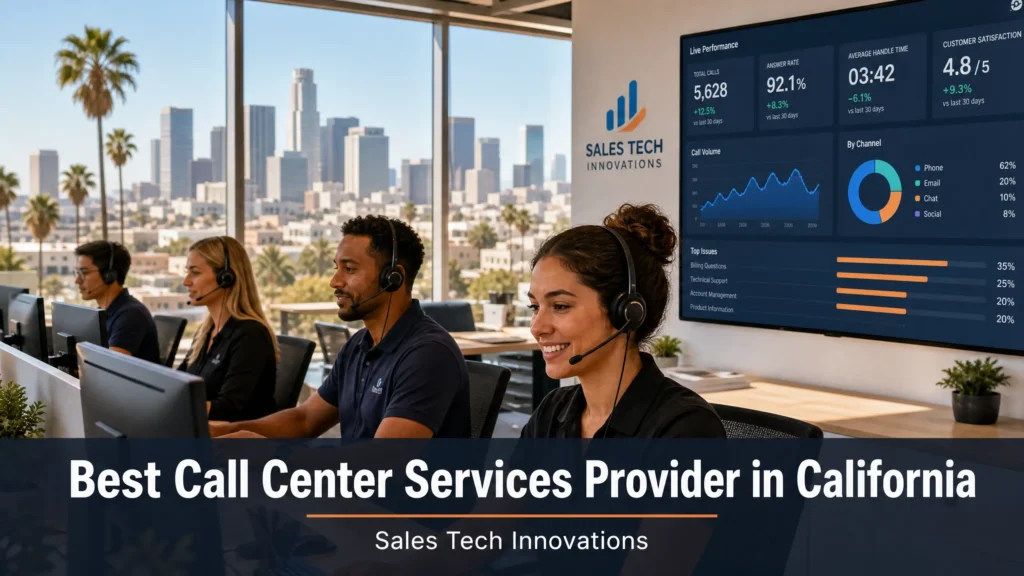
Once live, clients aren’t left guessing. Dashboards show call volume, how fast issues get resolved, satisfaction scores, and how individual agents are performing, updated in real time rather than bundled into some end-of-quarter report. When something is off, we fix it that week, not three months later after a review meeting flags it. That’s really the point of hiring a call center partner in the first place — plenty of companies can pick up a phone, but staying on top of the relationship after the contract is signed is where most of them fall short.
What Technology Keeps Everything Running Smoothly?
Without the infrastructure, it all falls apart — and it is always the very first thing that any cost-efficient company will cut back on. We use cloud-based call routing so that when all of a sudden we get a surge of calls in one particular location, the load is shifted to another group of agents instead of keeping people waiting in queues. Each individual call is recorded right away and then it goes directly to our dashboard.
CRM synchronization seems to be much more important for the business than the majority of our clients realize. It doesn’t matter whether your company is using Salesforce, HubSpot, Zoho, or any other CRM that is smaller and more niche. We will simply connect with what you are using. And the advantage is clear: without the customer even having to say anything, the representative would be familiar with all of the customer’s history.
As for quality control, it isn’t a once-a-quarter checkbox exercise here. Calls are randomly selected each week and evaluated based on their tone, accuracy, and how quickly the problem was actually solved. If an employee is doing poorly, he or she is immediately coached. While not necessarily the most exciting aspect of the position, it can often be the difference between a long-term provider and one whose quality deteriorates over a few months.
How Do We Measure Whether It’s Actually Working?
A number is only useful if it tells a business owner something they actually care about, so vanity metrics don’t get much airtime here. We track first call resolution, average handle time, customer satisfaction, and abandonment rate as a baseline, but the more important step is tying those figures back to what a specific client is actually trying to achieve. A great resolution rate isn’t worth much if satisfaction scores are drifting down at the same time and nobody’s noticed.
Every month, clients get a plain-language rundown of what’s improving and what needs attention — nobody’s handed a spreadsheet and left to figure it out alone.
Frequently Asked Questions
What industries does Sales Tech Innovations typically work with?
We support businesses across healthcare, retail, e-commerce, technology, financial services, and real estate, among others, with agents trained specifically for each industry’s terminology and compliance needs.
How quickly can a new account go live?
Most accounts are up and running within one to two weeks, depending on how complex the integrations are and how much custom training the account needs.
Do you offer both inbound and outbound services together?
Yes — most clients use a blend of both, and we structure teams so agents can shift between inbound and outbound work as call volume requires.
Is 24/7 coverage available for smaller businesses, or only large accounts?
24/7 support is available regardless of company size. We simply adjust staffing levels to match actual call volume, so smaller businesses aren’t paying for more coverage than they need.
How is pricing structured?
Most of the time it comes down to agent hours or call volume, billed monthly with nothing hidden in the fine print — no surprise per-minute add-ons showing up later. Before any contract gets signed, we’ll sit down and go through numbers based on what your actual call volume looks like, so there’s no guessing involved.
What happens if we’re not satisfied with the service?
New clients almost always start with a pilot period, and that’s on purpose — it gives problems a chance to show up early, while they’re still easy to fix. If something is off, we don’t wait around; scripts, staffing, or whatever process needs changing gets changed quickly. Nobody’s stuck in a contract that isn’t actually producing results.